Walking through art fairs where there are endless walls of great and dramatic paintings all vying for our attention it can be easy to overlook these artworks’ significant counterparts, the frames. Now, as a dealer and private collector in antique picture frames I guess I am biased, but I do believe these carved ornamental margins act as important visual mediators between the artistic image and the surrounding exhibition space. Providing context and informing our viewing of artwork.
I was delighted to be asked to give a talk at the CODART Patrons’ Salon during The European Fine Art Fair (TEFAF) in Maastricht last month, to discuss the role picture frames play in serving our understanding of paintings, the importance of reframing and how to choose which frame will do true justice to an Old Master.
A question I put forward was whether there can be a rational for reframing, a set methodology, seeing how historically collectors have framed their paintings in different manners and for a variety of motivations. Circa 1670, Cardinal Leopold de’Medici reframed his picture collection in the latest Baroque taste to hang in his second floor apartment of the Palazzo Pitti. As an extensive patron of the arts reframing allowed the Cardinal to put his personal stamp on the collection and assert his dynastic status.
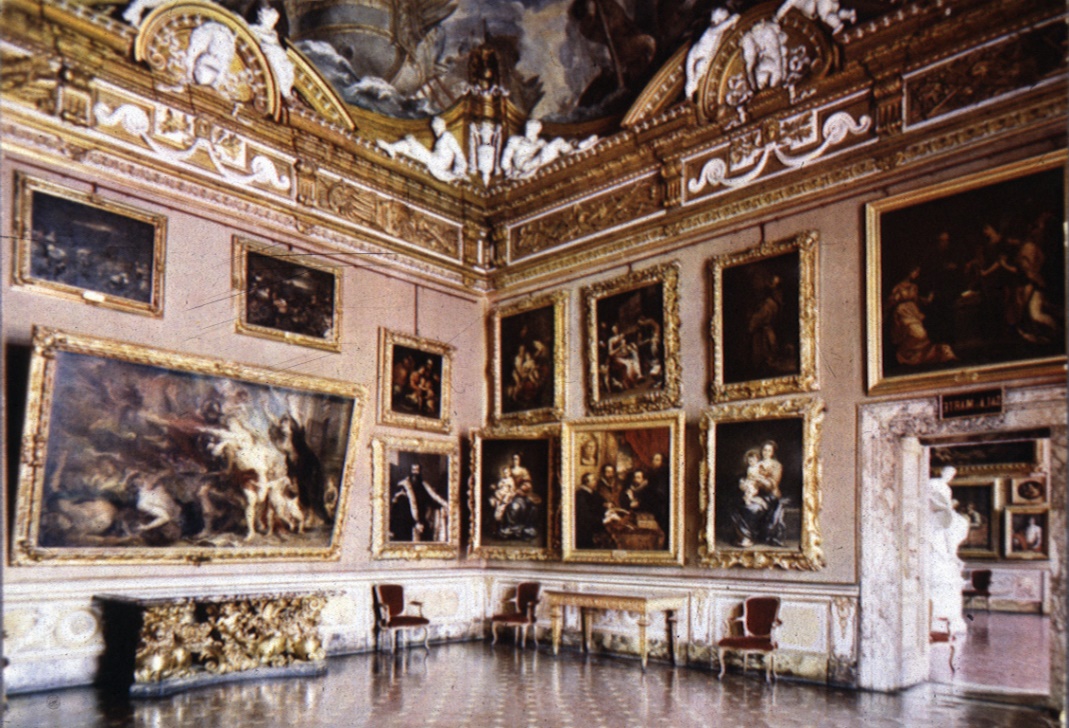
But reframing can also be simply a matter of taste and keeping current with latest fashions. The British statesman William Windham had a particular affection for marine and landscape paintings, mostly of the Dutch school, purchased either in Holland on his homeward journey from the Grand Tour in 1742, or soon afterwards in London. Whilst remodelling the cabinet room at Felbrigg Hall in 1751, to accommodate the bulk of his pictures, Windham reframed these paintings in beautiful rococo frames, noteworthy because of their re-cutting in gesso and rich water gilding. But what if provenance had taken precedence? Imagine how out of place dark and austere Dutch 17th century ebonised frames would have looked in Windham’s fashionable and flamboyant Rococo interior.


So what does this mean to the collector or curator in 2016? What should they be trying to achieve when reframing and how can a frame enhance the perception of a picture?
Well the prompt to reframe could be that a major painting within a collection is possibly adequately framed but is not distinguished by its framing.
Take for instance Gainsborough’s Blue Boy, which is not only the most famous picture in the Huntington Library but an iconic image globally. Sold to Henry and Arabella Huntington in 1921 by Joseph Duveen for roughly $725,000; making it the most expensive sale of a painting at the time. To add to Blue Boy’s legendary status, before it controversially left England for California it was briefly exhibited at the National Gallery in London where some 90,000 people came to catch a last glimpse of this striking youth adorned in brilliant blue.

The public approach this painting with an enormous expectation, and so the frame has quite a job to do!
When the painting arrived in San Marino, Blue Boy’s frame was likely the same one in which it was displayed by the previous owner, Hugh Grosvenor, 2nd Duke of Westminster. But by 1938, the Huntington’s curator of art Maurice Block was ready to respond to complaints about the painting’s “bulky 19th-century frame.” Block made use of a leftover frame in storage, a 20th century Carlo Maratta frame, which was wider and grander than its 18th century prototype.
The framing of Blue Boy was reviewed again in 2013 as it was framed in a similar style to other portraits in the gallery, and so was not appropriately distinguished. It is also worth noting that the frame was not original to the painting, and so could changed. I really enjoyed getting to work on this exciting project and looked at the possibility of reframing the painting in a Carlo Maratta or neo-classical frame from the 1770’s. However, this grand English rococo frame, as seen in the photo above, worked perfectly giving stature for a commanding centre wall position, whilst having its own intrinsic quality and craftsmanship.
Perhaps the history of Blue Boy underscores the significance of the marriage between picture and frame. Changes in culture, taste and curatorship demand us to evaluate our approach to pieces of artwork, and the process of reframing allows for opportunity to reinterpret, give new meaning and provide fresh light to our viewing of great Old Masters.
 BORDERS OF ART
Leave a comment